Customer Background
SparkX is an innovative company specializing in e-commerce advertising services, dedicated to delivering efficient, precise, and continuously optimized advertising solutions to sellers worldwide.
The company's core product, the Xmars platform, serves Amazon sellers and cross-border e-commerce sellers in China, the United States, and other overseas markets. It provides end-to-end services covering advertising strategy development, campaign execution, performance monitoring, and ongoing optimization. Through data-driven advertising operations, the platform helps sellers improve product visibility and traffic conversion, drive sales growth, and continuously optimize advertising efficiency and return on investment.
SparkX remains customer-centric and continues to advance product and service innovation, with the goal of becoming a trusted advertising growth partner for e-commerce sellers worldwide.
Key Challenges
Solutions
After a serious service disruption, and facing rising big data costs, AI adoption requirements, and global expansion needs, SparkX decided to migrate its core systems to AWS and rebuild the Xmars platform on a stable, elastic, and AI-ready cloud architecture.
CHALLENGE
Platform stability and business continuity risks
A cloud service provider outage in its Singapore region made the Xmars platform unavailable — during a live product demonstration at a customer site in the United States. Recovery took an extended period, affecting advertising delivery, data queries, and daily operations, and exposed gaps in high availability, disaster recovery, and cross-region resilience.
SOLUTION
High availability and disaster recovery on AWS
AWS Multi-AZ architecture, disaster recovery, and elastic scaling strengthen the stability and continuity of core services, while regional deployment improves access performance for overseas customers.
CHALLENGE
High big data costs, limited scalability, heavy operations
The instance-based HDFS and HBase storage architecture tightly couples compute with storage, amplifies storage consumption through replication and backups, and keeps the infrastructure and data teams busy with node scaling, capacity planning, data balancing, troubleshooting, and performance tuning.
SOLUTION
EMR + S3 data lake architecture
Amazon EMR and Amazon S3 decouple compute from storage. Compute resources scale elastically with demand while data is centrally stored in S3, and lifecycle policies with storage tiering effectively reduce storage costs and operational complexity.
CHALLENGE
Data and compute constraints for AI adoption
Advertising, product, traffic, conversion, and customer business data are fragmented across different systems, making it difficult to establish a unified, governed, and traceable data foundation. Highly variable demand for CPU and GPU resources from model training, real-time inference, and large-model applications is difficult to balance with the current resource model.
SOLUTION
A unified data and AI platform
With the AWS data lake, elastic compute, and AI/ML services, SparkX can progressively build a unified data and AI platform to support intelligent advertising optimization and generative AI applications.
CHALLENGE
Growing globalization and compliance requirements
Operating across China, the United States, and other overseas markets creates higher requirements for global infrastructure, high availability, access performance, and compliance capabilities.
SOLUTION
Global infrastructure and compliance assurance
AWS global infrastructure supports regional deployments and business expansion, while its security, encryption, access management, auditing, and compliance capabilities help meet the data security, privacy protection, and compliance requirements of U.S. and global customers.
Why AWS
AWS provides SparkX with cloud infrastructure capabilities that support global business development and meet the evolving needs of the Xmars platform in stability, elasticity, big data, AI, security, and compliance.
Global Infrastructure and High Availability
An extensive global infrastructure footprint supports regional deployment based on business needs in different markets, improves access performance for overseas customers, and strengthens the stability and continuity of core services through Multi-AZ architecture, disaster recovery, and elastic scaling.
A More Flexible and Cost-Efficient Big Data Architecture
With Amazon EMR and Amazon S3, SparkX can decouple compute from storage. Compute resources scale on demand according to data-processing workloads, while data can be centrally stored in S3, reducing the cost and management complexity associated with storage redundancy, backups, and cluster operations.
Enabling AI-Driven Advertising Innovation
AWS provides end-to-end capabilities spanning data lakes, elastic compute, and AI/ML services. These capabilities support SparkX in progressively building a unified data and AI platform and provide stable, scalable technical support for advertising strategy generation, performance forecasting, anomaly detection, intelligent diagnostics, and operational assistance.
Security and Compliance Assurance
Mature capabilities in identity and access management, data encryption, security auditing, and compliance certifications help SparkX meet the requirements of U.S. and global customers for data security, privacy protection, and compliant operations.
Architecture
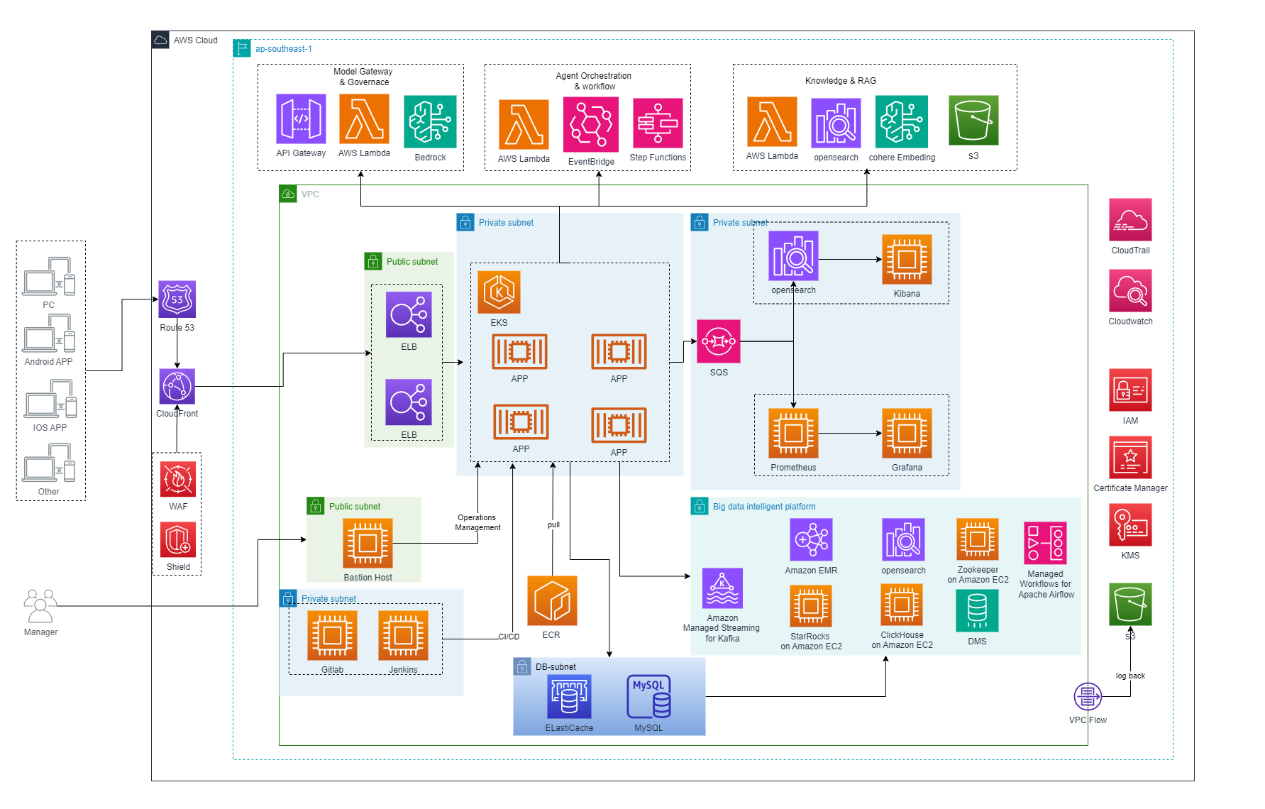
SparkX Xmars platform architecture on AWS.
Solution Highlights
Global Access and Security Protection Layer
Users access the platform domain through PCs, Android devices, iOS devices, and other endpoints. Requests are first resolved through Amazon Route 53 DNS and then distributed and accelerated through Amazon CloudFront — static resources are returned from nearby edge locations, while dynamic requests are accelerated back to the AWS application environment. Before traffic enters the VPC, AWS WAF filters web requests to defend against common web attacks, and AWS Shield provides DDoS protection to safeguard the security and availability of public access endpoints.
Application Ingress and Operations Access Layer
Requests processed by the edge layer enter the VPC and are received by ELB instances deployed in public subnets, which distribute them to backend EKS application services — multiple load-balancing entry points improve application availability and traffic-handling capacity. Operations personnel access private-network resources through a Bastion Host, avoiding direct exposure of applications, databases, and analytics components, while GitLab, Jenkins, and Amazon ECR support code management, automated builds, continuous integration, container image storage, and application releases.
Core Business Services Layer
Core business systems run in an Amazon EKS cluster in private subnets, with multiple application services deployed as containers. EKS manages container scheduling, service operations, failure recovery, and elastic scaling, enabling business services to adapt flexibly to changing workloads. Amazon SQS supports asynchronous messaging between applications — background processing, delayed tasks, retrying failed operations, and traffic smoothing during high-concurrency scenarios — reducing coupling between services and improving system stability.
AI Models, Agent Orchestration, and Knowledge Base Layer
Amazon API Gateway, AWS Lambda, and Amazon Bedrock provide a unified entry point for model invocation and governance, centrally managing AI requests, API authorization, routing, and model-service integration. Agent orchestration uses Amazon EventBridge, AWS Lambda, and AWS Step Functions to coordinate multi-step tasks, conditional logic, retries, and exception handling for complex intelligent-agent workflows. The knowledge base and RAG capabilities — built on Amazon S3, Bedrock Embeddings, Amazon OpenSearch, and Lambda — vectorize enterprise knowledge into OpenSearch and retrieve relevant context before Bedrock responds, improving answer accuracy and business relevance.
Database, Cache, and Streaming Data Layer
MySQL and ElastiCache are deployed in the data subnet: MySQL stores core business and transaction data, while ElastiCache caches hot data and frequently accessed results to reduce database load and improve system response times. Amazon Managed Streaming for Apache Kafka serves as the streaming-data and event-delivery platform, providing high-throughput, durable message streams that continuously transmit business events to downstream data-processing and analytics platforms.
Big Data and Analytics Layer
An independent big data analytics platform is composed of Amazon EMR, StarRocks, ClickHouse, OpenSearch, ZooKeeper, and Managed Workflows for Apache Airflow. EMR is used for large-scale data computation and processing; StarRocks and ClickHouse support high-performance analytical queries; OpenSearch supports search and log analytics; ZooKeeper provides coordination for selected distributed components; and Airflow manages data task scheduling and data-pipeline orchestration. The platform consumes Kafka streaming data and combines it with business data to produce analytical reports, operational insights, and search services.
Monitoring, Logging, and Auditing Layer
Amazon OpenSearch and Kibana provide logging and search capabilities, allowing application logs, system logs, and searchable operational data to be centrally collected and analyzed visually. Grafana provides unified monitoring dashboards for application, infrastructure, and business metrics; Amazon CloudWatch monitors AWS resource metrics, logs, and alarms; AWS CloudTrail records account and API activities to support auditability and traceability; and VPC Flow Logs capture network traffic information and can be archived in a dedicated S3 log bucket.
Security and Foundational Services Layer
AWS IAM manages permissions for users, operations personnel, application services, and CI/CD tools. AWS KMS manages encryption keys to protect data and logs, while AWS Certificate Manager manages HTTPS and TLS certificates. Amazon S3 serves as the foundational object storage service, storing knowledge-base documents, archived logs, data analytics files, backup files, and other business objects.
Customer Benefits
Improve Platform Stability and Business Continuity
With AWS Multi-AZ deployment, high-availability architecture, and disaster-recovery capabilities, SparkX can conduct a quantitative assessment based on historical operating indicators such as service availability, the number of major incidents, mean time to recovery (MTTR), the number of affected users, and business interruption duration. The target is to raise core business availability to at least 99.95% and reduce the impact of failures on advertising delivery, customer experience, and daily operations.
Improve Data Processing and Operations Efficiency
Leveraging AWS elastic compute capabilities, SparkX can flexibly adjust compute resources for different workloads, including ETL, report generation, and advertising strategy calculations. Core data-task efficiency is expected to improve by 20%–40%, while lower-level cluster operations effort is expected to decrease by more than 30%, allowing the infrastructure and data teams to devote more capacity to business innovation and data applications.
Accelerate AI Adoption and Global Business Expansion
Based on indicators such as model training and deployment cycles, data preparation time, the number of AI use cases launched, overseas response times, and new-region deployment cycles, SparkX can use AWS data lake, elastic compute, and AI/ML services to build a unified data and AI platform. The time from AI validation to production is expected to fall by 30%–50%, improving regional deployment efficiency for overseas operations and supporting advertising strategy generation, performance forecasting, anomaly detection, and operations.
About the Partner
QINEASY
We are an AWS Premier Consulting Partner with deep expertise in AWS cloud services and multiple AWS specializations spanning security, big data, and operations. Combining advanced cloud technologies with in-depth industry insight, we help innovative businesses build a future-ready digital foundation and accelerate their global success.
About AWS
AWS
Amazon Web Services (AWS) is a leading global cloud computing provider, offering a comprehensive range of services across compute, storage, databases, the Internet of Things, security, and compliance. With flexible service models and an extensive partner ecosystem, AWS helps businesses reduce IT costs and improve operational efficiency. It provides a reliable technology foundation for digital transformation and international expansion, supporting business growth and innovation.